When it comes to the recitation of the Psalms for magical purposes, I personally prefer doing so in Hebrew, since I concur with those Kabbalists who believe every word of the Hebrew Psalms to be a “Holy Name,” the utterance of which will invoke specific forces with very definite effects. For that reason it would be extremely important to pronounce the words correctly, and this is not as easy as it may seem. Besides the inability of most readers to do so, as they are not familiar with Hebrew and will probably have to learn the psalms “parrot fashion,” mistakes could creep in during the utterance of a specific psalm, which might invoke psycho-physical responses not quite bargained for. The pronunciation of Hebrew words is in itself a problem, as there are different ways of speaking Hebrew amongst different communities. In this regard, as far as I have been taught, it is most important to know how to pronounce a Hebrew word, yet with some reservations, since the utterance of Divine Names equally differs amongst the various factions.
Psalms.....Psalms.....Psalms everywhere, used for every imaginable “magical purpose,” hence a full investigation into the “Magical Use of Psalms” is important, and warrants more than superficial perusal. In fact, such a study deserves to have the entire
Shimmush Tehillim presented here. However, in this present volume of the “Shadow Tree Series,” we will pay attention to the employment of Psalms and other portions of the
Tanach (Hebrew Bible) in Hebrew amulets only. It should also be kept in mind that the Psalms and their respective verses are presented in the order they appear in the Hebrew Bible, which is different from their format in the Protestant Christian Bible. Hence we will commence this investigation with the first Psalm employed for “amuletic” purposes, which is in fact
Psalm 1. The anonymous author of the
Sefer Shimmush Tehillim instructs us to write the first three verses of this Psalm on deer skin to be worn as a pendant, for the purposes of preventing a pregnant woman from premature delivery or from suffering a miscarriage. The mentioned verses read:
Transliteration: (Verse 1) Ashrei ha-ish asher lo halach ba’atzat r’sha’im uv’derech chata’im lo amad uv’moshav leitzim lo yashav
(Verse 2) Ki im b’torat YHVH chef’tzo uv’torato yeh’geh yomam v’lailah
(Verse 3) V’hayah k’etz shatul al palgei mayim asher pir’yo yiten b’ito v’aleihu lo yibol v’chol asher ya’aseh yatzli’ach
Translation: (Verse 1) Happy is the man that hath not walked in the counsel of the wicked, nor stood in the way of sinners, nor sat in the seat of the scornful.
(Verse 2) But his delight is in the law of YHVH; and in His law doth he meditate day and night.
(Verse 3) And he shall be like a tree planted by streams of water, that bringeth forth its fruit in its season, and whose leaf doth not wither; and in whatsoever he doeth he shall prosper.
We are informed the associated Divine Name is
El Chad 
, which Selig informs us is signifying “great, strong, only God.” The term “
Chad” in the Divine Name does not really mean “great,” “strong” or “only.” The Hebrew term means “sharp” or “acute.” The translator may have derived the meaning of “only,” by seeing a connection between the words “
Chad” and “
Echad,” the latter meaning “one.” As it is, the Divine Name,
El Chad, was derived from the initial letters of first, second and fourth words, and the last letter of the second as shown below:
 from
from  (Ashrei — “Blessed” [verse 1]);
 from
from  (Lo chen—“not so” [verse 4]);
 from
from  (Yatzliach—“prosper” [verse 3]; and
 from
from 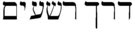 (Derech R’sha’im—“way of the ungodly” [verse 6]).
I cannot quite fathom why the author chose these specific words in the mentioned verses, as there are several others he might have chosen, and which would have sufficed equally. For example, the word
Derech appears several times in the Psalm, in fact in the very first verse. So why select the term from verse 6, when the latter is not employed in the amulet? I am also left somewhat stranded, when I thought that I might find a meaning by reading the four words as a sentence. This proved to be somewhat nonsensical. Of course, one could “force” a meaning out of it, but I prefer to leave this to the speculations of those more intrigued than I am by this peculiarity in the
Sefer Shimmush Tehillim. Be that as it may, to complete the construction of the amulet in question, we are informed to include on it the following prayer:
Transliteration:Y’hi ratzon milfanecha El Chad sheta’aseh l’ishah [.....fill in the name of the woman.....] shelo tapil v’tirpa’enah r’fu’ah shleimah mei’atah v’ad olam omein omein omein selah selah selah
Translation: May it be your will El Chad to protect this woman [.....fill in the name of the woman.....] against miscarriage and to heal her completely forthwith and throughout eternity. Amen Amen Amen, Selah Selah Selah.
Curiously enough, the same three verses from the first Psalm are also recommended as an amulet to promote success in all ones endeavours. In this regard the specific reference is to the concluding phrase of verse 3 reading "and in whatsoever he doeth he shall prosper."
(More to follow)


 Posts
Posts